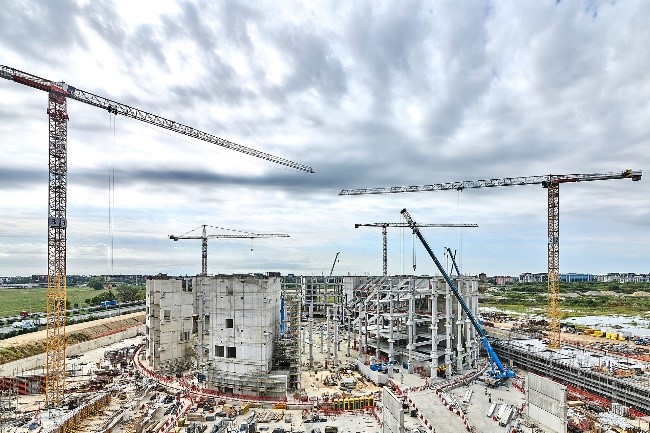
In February, most of the crowd at the Arena Santa Giulia will focus on the action at center ice as they watch the world’s best hockey players participate in the 2026 Winter Olympics. However, I’m sure that a few concrete enthusiasts will examine one of the only two new buildings built for the entire celebration and take pride in the role concrete played in its construction.
An Olympic Concrete Showcase
Arena Santa Giulia is a testament to concrete’s versatility—sculptural, structural, and sustainable. David Chipperfield Architects designed the stadium. Concrete enabled the team to merge architectural ambition with engineering discipline, delivering a venue built to endure beyond the Games while honoring Milan’s Roman heritage.
Design Intent
The new event venue is a key part of Milan’s southeastern district’s reinvention following Foster + Partners’ Santa Giulia masterplan that connects transit, green space, and public life.
Chipperfield followed this design philosophy by creating a vibrant space for shared experiences. The site features a 10,000-square-meter public piazza, establishing a community gathering space reminiscent of a Roman forum. The structure’s elliptical form continues this theme by echoing Milan’s ancient Roman amphitheater, creating visual continuity between past and present. Following the Olympics, the owners will transforms the hockey stadium into Italy’s largest indoor entertainment venue, with plans to host concerts, festivals, and sporting events.
Concrete Innovation
Arena structural engineers specified on concrete recipes that prioritized durability and long-lasting performance in Milan’s extreme mountainous environment. Material engineers opted for high-performance concrete mixes with low permeability and enhanced compressive strength for the load-bearing elements. The strength of these concrete mixes accommodated the structure’s 40-meter height and elliptical geometry, spanning 175 meters by 145 meters.
The mixes were robust enough to allow contractors to cast the exposed concrete surfaces with smooth formwork, highlighting architectural detailing and material color uniformity.
The mix designs also included recycled aggregates and supplementary cementitious materials, which reduced the as-built carbon footprint, aligning with Milan’s sustainability goals.
You can learn more about this structure and how concrete construction participated in other Olympic site projects. Liebherr recently posted a news item describing how contractors combined technology and expertise to achieve success in event planning as reported in Liebherr Cranes at Work for the 2026 Winter Oympics.
You can also learn about the equipment manufacturer at www.liebherr.com, or visit Liebherr USA at World of Concrete 2026, Booth C6049 and Booth N844
**Summary:** Arena Milano combines advanced concrete engineering and parametric design to create Italy’s largest indoor venue for the 2026 Winter Olympics.
 What's Happening in Concrete Construction